Sunday, 10 January 2016

2016 BMW X5 xDrive40e

A painless, if pricey, way to boost your SUV's green cred.

 The first thing you need to know about the new plug-in-hybrid version of the BMW X5 is that the EPA rates its electric-only range at just 14 miles—and, of course, your results may vary. Which is another way of us saying that you’ll need good luck to go even that far between charges.  

So you shouldn’t expect the X5 xDrive40e to be a Chevy Volt writ large. Commuting on electricity is possible only for those who have a very short drive. A 14-mile range would be just enough to allow you to traverse Manhattan from north to south (or vice versa), assuming mild traffic. Plus, the top speed in EV mode is 75 mph, so if your commute includes any expressway driving, you’re better off selecting the Save Battery mode and reserving the EV driving for city streets. Also, in EV mode the X5 xDrive40e needs 22.6 seconds to reach 60 mph. That is just 0.8 second quicker than a 2011 Smart Fortwo ED. And it should be noted that using the inline-four to charge the battery (as also occurs in Save Battery mode) is hardly an efficient practice. 

If saving dollars at the pump is your goal, leave the X5 in Auto eDrive (hybrid) mode and plug it in as often as you can. We averaged just 21 MPGe, which is lower than expected. To be fair, our result may have been slightly dragged down due to a few drivers using the engine to charge the battery in order to experience the EV mode. By comparison, an X5 xDrive35d returned 25 mpg in our hands. The diesel also boasts a 6-mpg advantage in the EPA highway ratings, at 31 mpg versus the 40e’s gasoline-only 25-mpg score (the diesel also has a 1-mpg-higher EPA city rating of 24 mpg). The diesel also is $4400 less expensive. But diesels don’t have the eco-friendly cachet of a plug-in hybrid, especially now.
 

The X5 40e is a very conventional hybrid setup. It pairs a 2.0-liter turbocharged inline-four with a 111-hp electric motor and an eight-speed automatic. The engine on its own makes 240 horsepower and when combined with the motor can deliver up to 308 horses, which is very close to the turbocharged inline-six that powers the X5 35i. But whereas the 35i’s engine must motivate 4934 pounds, the 40e’s batteries mean it’s saddled with 5283 pounds—thus, the 40e trails the 35i to 60 mph by two-tenths, at 6.2 seconds.
That difference, however, is largely irrelevant in everyday driving. There’s never a feeling that a measly 2.0 liters isn’t enough; the X5 40e has more than adequate power. Plus, the hefty five-seater is dynamically sound. It carries its weight well, pitching and rolling like any big SUV, but without the extra commotion associated with poorly tuned dampers. This is no back-road carver, but it’s not supposed to be.

 
Its only dynamic failing is a spongy brake pedal that requires some concentration for smooth stops. When are makers of hybrids going to figure out that a blended brake system isn’t the way to go? There are settings in modern cars for everything; why not have a regenerative setting (as in the all-electric Tesla Model S) and have the brake pedal solely operate the mechanical stoppers? It makes sense to us.
One of the best things the X5 has going for it is the seating position. The current generation may have lost a little of that truly commanding feeling—you know, when the car’s beltline is nearly on the same plane as your own—but visibility is great for a big ute. And this large SUV also has a full measure of utility. Fold the rear seats and 73 cubic feet await your Costco needs. The battery pack located under the cargo floor, however, means you can’t get a third-row seat as in other X5s.
The 40e may not be the most efficient X5, but at least it doesn’t drive like a moving penalty box. Its premium pricing shows that, in the automotive realm, making an environmentally conscious statement often isn’t cheap. Add “SUV” to that equation and it gets even pricier.

2016 Ford Mustang Shelby GT350 / GT350R

Ford moves the muscle car to a higher order.


We’ve been here before. We’ve stared down the barrel of a twin-striped Mustang with more than 500 horsepower and the name of a Texas chicken farmer across its fanny. The last one, the 2013 Shelby GT500, had 662 horsepower, in fact, and was said to go over 200 mph. It didn’t, not for us, anyway. Even so, it was what a Shelby Mustang should be, what it has been for decades: a hot quarter-mile with a side of smoky burnout. It was a muscle car with more. Mustang lovers got sweaty, but as usual, the rest of the auto world just shrugged and moved on with evolution.  

Ford says it’s different this time. It says the new Shelby GT350, a name positively gestational with history, is a light-year leap in sophistication and handling. It says the flat-plane-crank V-8 delivers 8000 revelations per minute, that the magnetic suspension and custom, cross-drilled brake system and Michelin superstick tires prove that the company is serious about achieving world-class handling.

Well, Ford says a lot of things.
Our natural skepticism, honed to a katana’s twinkle by years of Shelbys with skull-rattling rides and plodding dynamics, marched proudly into the cockpit of the new GT350—whereupon it died instantly on the car’s red start button. Vaa-ROOOOOMpapapapapapa!!!!
Oh. Maybe they’re serious this time.

With the six-speed slotted into gear and the surprisingly light clutch lifted, the GT350 leapt onto the asphalt of Monterey’s Mazda Raceway Laguna Seca. First corner and first impressions: tight, tied-down, stable, maybe a little bit of push but, hey, the car’s cold and a bit heavy. Wind it out—wait, where’s the redline? Nowhere. It doesn’t exist! The sucker just keeps straining, keeps revving, keeps swelling with a glorious brassy, unmuffled, rhapsodic roar.
The anticipated upshift was forgotten as another corner approached.
The brakes—oof, such brakes!—chomp down, but the nose doesn’t dive. The car isn’t crossed up or squirming, it’s flat and stable and ready to turn right now! Less understeer this time, a perfect arc scribed from the white line to apex to white line. And it’s on the gas again, the sound flooding back—that addictive, dazzling, erotic exhale of lyric fire.
Yes. Yes, indeed. Ford is serious.
With the $49,995 GT350 and the even more track-ratty $63,495 GT350R, Ford wants to quit the pony-car sphere that the Mustang has inhabited since 1964. Supposedly using Carroll Shelby’s original race-ready Shelby GT350 as its guiding Polaris, the engineers set out to build a no-excuses track machine, more multitalented than the GT500 blunderbuss it replaces. That car was all about muscle power and 200 mph. This one is a little lighter, a lot more lithe, and perhaps able to finally get the attention of non-muscle-car types. You say you have a BMW but want something different, possibly American-made, but a Corvette isn’t your thing and a Camaro Z/28 is too brutish? Ford wants to talk to you.

Not that the new Shelby isn’t quick, but it’s not a dedicated quarter-mile eater, either. The base GT350 reaches 60 mph in 4.3 seconds after a somewhat difficult launch and does the quarter-mile in 12.5 seconds at 117 mph. Perhaps not stunning numbers these days, but the test car did weigh 3796 pounds. With its 18-pound carbon-fiber wheels and stickier Pilot Sport Cup 2 tires, the R (at 3710 pounds) makes it to 60 in 3.9 seconds and through the quarter-mile in 12.2 seconds at 119 mph. Guess what? Porsche 911 GT3 drivers don’t jump up and down about drag-strip times. Stats that matter to them more are skidpad grip and braking distances. There, the 350 and 350R pull 0.98 g and a startling 1.10 g, while stopping from 70 mph in 152 feet and 146 feet. Ford’s priorities become clear when you check the track-sheet data.
In the grander scheme, this is part of the internationalization of Ford’s U.S. product line in general, from Fiestas to Transits. Today’s auto-industry economics demand that you play on a world stage, which in a sporty car means world-class dynamics. The Mustang can no longer be just an island of romantic longing for drag-strip Christmas trees and fluorescent-lit drive-ins.
Okay, yes, the GT350 is North America–only for the time being, but its mien and manners are more BMW M4 than typical monster Mustang, even if the tire-shredding line-lock feature carries over into the Shelby. Really, the Cadillac ATS-V coupe, so enriched and able, is a better comparison to the GT350 than what seems to be its natural domestic competitor, the outgoing Chevrolet Camaro Z/28.

Well, the Cad is a good comparison except for the Shelby’s oddly unique V-8. We’ve complained about turbo engines and their lack of character. You want an engine with character? The GT350’s “Voodoo” V-8 is Brad Pitt, the Terminator, and James Bond coming at you with matching wry grins.
Everybody wants to know first what this 5.2-liter, 526-hp engine sounds like. Even when making its full 92-decibel war cry, it’s not a loping boom-boom like we’re used to from a muscle car, but rather a faster, more syncopated thrum that is more like what you hear from a Ferrari. Still, it doesn’t sound like a Ferrari, mainly because it doesn’t breathe like a Ferrari.
In case you’ve missed our many prior memos on the subject, here is a highly condensed update: This is a slightly bored and stroked version of the Mustang GT’s 5.0-liter V-8 but with a flat-plane crankshaft, meaning the connecting-rod journals are 180-degrees out, like in a Ferrari 458 or a Ferrari California, rather than at 90-degree intervals as on almost every other V-8 in production.
The Mustang does not wail like a Ferrari, however, because Ford’s engine is quite different. For one thing, it has a single intake and dual exhausts, as opposed to a dual intake and a single large muffler, as on a Ferrari. Also, rather than the Ferrari’s setup of, effectively, two four-cylinder engines joined at the crankshaft, where the center two pistons of each bank are 180 degrees out from the outer two, the Ford has a different arrangement. It puts each piston 180 out from the next one in line. This is mainly because Ford wanted a single large throttle body for better packaging and a power spread more befitting a Mustang.


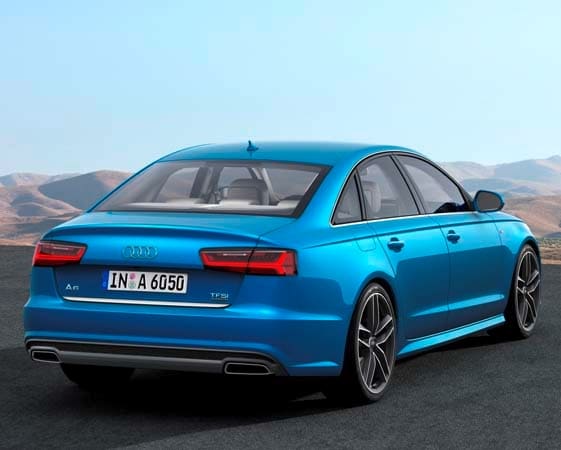
2016 Audi S6

A highly stylish, speedy, and slightly sterile machine.

When the current generation of the swift, sexy Audi S6 was first launched for 2013, it and the A6 sedan on which it’s based secured a spot on our 10 Best Cars list. Then they did it again the next year. While other, newer vehicles have supplanted the mid-size Audis on our 10Best list, the S6 nevertheless has improved for 2016, with a styling update shared by all A6 derivatives and the addition of another 30 horsepower under the hood. 


That brings the pony count of its twin-turbocharged, direct-injected 4.0-liter V-8 to 450, available from 5800 to 6400 rpm. (This means the S6 now officially outmuscles the previous-generation S6, which was motivated by a Lamborghini-derived 5.2-liter V-10 with 435 horsepower on tap.) Torque, however, remains pat at 406 lb-ft from 1400 rpm. The extra muscle didn’t seem to make a difference when we took the 2016 S6 to the track, though. In fact, this car was a touch slower than the last S6 to which we strapped our measuring devices, with the zero-to-60-mph run taking 3.9 seconds, versus the previous car’s 3.7. Blame the additional weight that has piled on since 2013—this particular test car carried 134 more pounds than the last one. Still, these are damned impressive numbers for a car that weighs nearly 4400 pounds.  


On the road, the S6 is more than just fast in a straight line. Equipped as ours was with the optional S6 Sport package—which brings adjustable steering effort, a reprogrammed rear-axle torque-vectoring system, and a sport exhaust (which we’d love to be even louder)—nothing seemed to upset the S6. It is brisk, precise, and solid in sweepers, while the standard adaptive air suspension affords it a calm and supple freeway ride in its Comfort setting. Auto and Dynamic modes are notably firmer. Fortunately, the standard Drive Select system allows for the individual tailoring of powertrain, steering effort, and ride characteristics. Even in the chassis’s firmest settings, however, tighter corners serve as a reminder that the S6 is no dainty petunia—and that a fair chunk (57 percent) of its weight sits atop the front axle. We noted moderate understeer while pulling an impressive 0.92 g on the skidpad (with the optional summer rubber).
The S6’s styling updates are fairly minor, basically involving reconfiguring the head- and taillamp innards with nifty jet-age cues but nothing to make the car stand out any more than before. Our test example featured Audi’s optional 20-inch wheels—a $1000 upgrade—but even that doesn’t elevate the car to head-turner status. And we suspect that might be fine with a good many S6 drivers, once they realize how fast this car is. Some attention is fun, after all, but not all attention is desirable.
As with most Audis, the exquisitely assembled interior of the S6 is as antiseptic as an operating table, especially at night when cold white LED lighting blankets the cabin. Yet its premium feel is beyond reproach, and special S6-specific touches like the firm yet supremely comfortable diamond-quilted seats and racy carbon-look dash trim afford it a sense of occasion that helps to justify the price. The MMI system remains one of the best infotainment setups in the business, and for 2016 it is enhanced with 4G LTE data streaming, INRIX online traffic information, Apple Siri Eyes Free integration, and internet-radio streaming.

At $80,775 as tested­—hardly chump change, but still fairly reasonable compared to a BMW M5 or a Mercedes-Benz E63 AMG—the S6’s value in the segment is matched only by Cadillac’s similarly priced, 640-hp CTS-V. If there’s anything missing here, it’s character. This is the kind of performance sedan that wins more minds—and yes, comparison tests—than hearts. It will be interesting to see how the S6 fares over time, however, as it eventually faces off against the Caddy and upcoming stormers like the 505-hp 2017 Alfa Romeo Giulia Quadrifoglio and the 2017 Mercedes-AMG E63, both of which we expect to be rich not only in power but in character, too.


2016 Ram 3500 Diesel Crew Cab 4x4

 The quintessential workaholic.


It’s pretty clear (or should be) that this is not the sort of truck that one would call a lifestyle vehicle—i.e., not a truck you’d expect someone to use as a car substitute. The Ram 3500 is the sort of truck that gives even a temporary owner a powerful urge to stop off at Tractor Supply Co. for a Carhartt jacket, steel-toed work boots, and rawhide gloves. And maybe 20 rolls of barbed wire, a couple dozen bags of cement, and one of every welder they sell. That’s what this big Ram is all about: work. You can outfit the interior with lots of fancy options—our test truck included $18,045 in extras, but most of that total went to work-related enhancements. Still, upscale features like leather, navigation, heated seats, premium audio, and Uconnect telematics spread only a thin veneer of civilization over a primordial brute with a work ethic that makes your average Calvinist look like a slacker.
 

To put the Ram 3500 into perspective, here are some noteworthy numbers: 385 horsepower, 900 lb-ft of torque, up to 7390 pounds of payload capacity, 31,210 pounds of maximum towing capacity. The turbo-diesel V-8s in the Ford and GM behemoths huff up more horsepower than does the Ram’s 6.7-liter straight-six, but the Cummins engineers keep mining more torque, with an increase of 35 lb-ft over the 2015 version. That increase is just enough to give this Ram a 40-lb-ft advantage over Ford’s Power Stroke V-8, although we should add that there are two tamer versions of the Cummins 6.7-liter six: 350 hp/660 lb-ft and 370 hp/800 lb-ft. The max Cummins gives this test truck a smallish edge in torque over Ford’s F-350, which helps yield a big edge in towing (3610 pounds, assuming both were set up for gooseneck trailers) but a sizable disadvantage in payload (990 pounds) to the F-350 we tested recently. 


Hook this baby up to certain riverbanks and you could change state boundaries. But again, this is no work-on-Monday, cruise-on-Sunday ride. A mile or two on almost any surface is enough to tell you that no pavement irregularity is too small for the suspension to ignore.
To be fair, suspension elements designed to support near-four-ton payloads are going to be stiff when there’s nothing in the cargo bed. Nevertheless, the Ram’s ride quality is something to be endured rather than enjoyed. And while the Cummins turbo-diesel is nothing if not manly, it will never be mistaken for a gasoline engine. It’s not as noisy as pre-common-rail diesels, but it leaves no doubt that what’s going on under the hood does not involve spark plugs. GM’s diesel heavy-duty pickups, the Chevy Silverado 3500 and GMC Sierra 3500, are both quieter and smoother on lumpy surfaces than their Ram and Ford rivals.
Diesels are also about efficiency, of course, and the Ram surprised us by logging 16 mpg over the course of our test, albeit almost always unladen. No surprise about acceleration, though: The zero-to-60-mph sprint consumed 8.6 seconds—about what you’d expect from a vehicle weighing well over four tons. Ford’s F-350 Super Duty, which weighed 100 pounds less, hit the mile-a-minute mark almost a second quicker. But the big Ford was substantially thirstier than the Ram, recording 12 mpg. (There are no EPA ratings for trucks in this class.)
 
As you’d expect of a four-door, long-bed behemoth dualie, the Ram’s responses are deliberate. Grip—0.70 g on the skidpad—is so-so, despite the substantial contact patches provided by six Nexen Roadian HTX tires (235/80R-17). And stopping distances are typical for this class—206 feet from 70 mph, or two-thirds the length of a football field. Although they suffered no fade, our Ram’s brakes shuddered with hard applications as the rear axle hopped to a stop.
The big work ethic that goes with an HD turbo-diesel carries a pretty big price tag. In any of the three big boys that make up this all-domestic class, the diesel engine alone costs well over $8000. In our Ram test truck the Cummins added $8995 to the bottom line, almost half of the $18,045 options total. The Aisin six-speed automatic was $2595, auto-leveling rear air suspension was $1595, and dual rear wheels added $1200. Our as-tested total crested $75,000.
All of the foregoing emphasizes the Ram’s big-job capabilities. Just be sure your jobs are as big as the truck—and that they pay well.

Volvo S90

First Car in the US To Be Fitted with Standard Semi-Autonomous Tech

Volvo’s handsome S90 sedan will enter into a packed and high-tech market when it goes on sale in the U.S. toward the end of 2016. But it’ll pack one feature nobody else offers in the U.S. market: self-driving technology as a standard feature.
The S90 will utilize the second generation of Pilot Assist, Volvo’s semi-autonomous driving tech that was first featured in the XC90 SUV. In the SUV, the feature tracks a vehicle driving in front of you to know when to accelerate, brake, and steer, at speeds up to 30 mph and when lane markings are clearly visible to the system’s cameras. The second-gen Pilot Assist, standard in the S90 sedan, will be able to accomplish those same tasks without needing to follow a car in front, according to Volvo. It also will perform these functions at speeds up to 80 mph.
 
Volvo says the S90 will be the first car sold in the U.S. with semi-autonomous driving as a standard feature. It’s part of Volvo’s Vision 2020, a self-imposed goal by the automaker to eliminate deaths and serious injuries in its new cars by that year. 

Wednesday, 6 January 2016

2016 Jaguar F-Pace revealed

The F-Pace will reach the UK next spring, priced from £34,170. It is the first SUV in Jaguar’s 70-year history and will be crucial, along with the XE saloon, in underpinning the future prosperity of the firm.
The F-Pace and XE should help to lift Jaguar’s annual volumes past 200,000 units. Last year it sold 81,000 cars. The F-Pace is expected to outsell the XE globally, which further highlights its significance to Jaguar.
 
Based on the same modular aluminium platform as the XE and new XF saloon, the F-Pace is targeted at everything from the BMW X3 to the Porsche Macan in the premium mid-size SUV segment. Although it shares a common architecture with the XE and XF, Jaguar says 81% of the car's parts are new. Around 80% of the F-Pace's body is aluminium, and the car's body in white weighs just 298kg - about the same as a Fiat 500L.
Other materials include a composite tailgate, magnesium for the front end carrier and steel for the doors.
A varied model range at launch includes the most frugal diesel in the class and a full-blown sports variant with an engine and chassis technology from the F-Type sports car.
The F-Pace’s overall look and feel are broadly in line with the C-X17 concept car of 2013, the model that was the first visual proof of Jaguar’s intention to launch an SUV. Indeed, an SUV has been promised by the firm since 2012, when then boss Adrian Hallmark revealed one was in the works when speaking to Autocar at the Geneva show.

Jaguar F-Pace versus the Frankfurt motor show
The F-Pace sits between the XE and XF in length. It’s 4731mm long, 1936mm wide and 1652mm tall, with a 2874mm wheelbase and a ground clearance of 213mm. This makes the F-Pace marginally longer and wider than the X3. It also has a longer wheelbase than the X3 and practically matches the BMW on height.
From launch, Jaguar will offer one petrol and two diesel engines, rear and all-wheel drive and five trim levels. The F-Pace has a 50:50 weight distribution
The entry-level 178bhp, 318lb ft diesel is the 2.0-litre four-pot unit seen in the XE and XF. As standard, it is hooked up to a six-speed manual gearbox driving the rear wheels. In this form, the F-Pace is claimed to be the most frugal car in its class, with 57.7mpg combined fuel economy and CO2 emissions of 129g/km. It covers 0-60mph in 8.5sec and has a 130mph top speed. This engine can also be paired with all-wheel drive, at which point an eight-speed automatic gearbox becomes optional.
V6 diesel and petrol models are also offered. Both come with all-wheel drive and an eight-speed auto. With 296bhp and 516lb ft, the diesel verison is capable of 0-60mph in 5.8sec and a 150mph top speed. Economy is 47.1mpg and CO2 output is 159g/km.
The petrol V6 is a 375bhp, 332lb ft supercharged 3.0-litre unit taken from the F-Type. This can crack 0-60mph in 5.1sec and reach a top speed of 155mph. This model is aimed squarely at the Porsche Macan Turbo, a model with a 395bhp V6 and a 4.8sec 0-62mph time.
Jaguar F-Pace to spawn SUV family
Jaguar sources have indicated that a version of the F-Pace with even greater performance is planned, a model that could be powered by a supercharged 5.0-litre V8 and wear SVR badging.
The F-Pace shares its advanced double wishbone front and Integral Link rear aluminium suspension with the XE and XF, along with the saloons’ electric power steering. Jaguar suggests the F-Pace will be the best-driving model in its class, with benchmark ride and handling.
A whole host of chassis technologies has been fitted to the F-Pace, including torque vectoring, an optional electric adaptive damping system and tunable driving modes that adjust functions such as throttle mapping, transmission shift points and steering feel.
 

COPO Camaro Based on Sixth-Gen Car Debuts

 Based on Sixth-Gen Car Debuts


Chevrolet is producing a limited run of 69 COPO Camaro race cars for 2016, and, for the second year in a row, the first one will be auctioned for charity. Designed for the NHRA’s Stock and Super Stock Eliminator classes, the 2016 COPO Camaro makes its debut at the 2015 SEMA show in Las Vegas. Chevrolet first resurrected the COPO name back in 2012, when the bow-tie brand decided to pit its then fifth-generation Camaro against the Dodge Challenger Drag Pak and the Ford Mustang Cobra Jet on the drag strip. Now in its sixth generation, the latest COPO Camaro reaps the benefits of the new lighter and stronger design, the COPO’s body-in-white structure yielding a savings of 133 pounds. Structural rigidity is improved, too, up by a claimed 28 percent thanks to extensive computer-aided engineering. Chevy hasn’t published any data yet but says the aerodynamics of the new COPO car are superior to those of the fifth-gen COPO.
 

As with the previous COPO Camaros, the chassis and suspension are tuned for drag-strip duty. Up front is a lightweight, adjustable strut-type suspension and unassisted rack-and-pinion steering, while a four-link setup with adjustable coil-overs, a Panhard bar, and a stabilizer bar handle the duties in the rear; wheelie bars keep the nose from going airborne. To endure the hard-core abuse, the COPO ditches the production Camaro’s independent rear axle, replacing it with a solid unit with an aluminum center section featuring a spool-type diff and 40-spline, gun-drilled axle shafts. Weld lightweight racing wheels and Goodyear racing tires are utilized for rolling stock, and lightweight, racing-type, unassisted four-wheel disc brakes are supplemented by a parachute to slow the COPO after a quarter-mile blast.
Engine choices for the latest COPO Camaro are predicated on the buyer’s intended class of competition, so Chevy makes a variety of supercharged and naturally aspirated LS- and LT-family engines available: a supercharged 350 (5.7-liter), a naturally aspirated 427 (7.0-liter), and an all-new LT-based 376 (6.2-liter). All three come backed by a racing-prepped Turbo 400 three-speed automatic transmission; fueling is handled by a fuel cell with a built-in high-pressure pump.
 

As you might expect, each COPO Camaro race car is built by hand, and that includes the number-one car, which will be auctioned for charity at an upcoming Barrett-Jackson sale, with the proceeds going to the United Way. Designed by drag racer Courtney Force, the charity car features bright red livery and slash marks toward the back. In addition to the NHRA-certified chrome-moly roll cage and five-point safety harnesses, the charity car comes with Courtney Force’s signature and the COPO logo on the lightweight racing bucket seats.
As before, would-be buyers must register at chevrolet.com/performance/copo-camaro. An independent third party will randomly select purchasers from the pool of interested customers to determine which of the 69 individuals are worthy of purchasing a 2016 COPO Camaro race car.